Why Men Avoid Therapy and What Changes When They Try It?

Many men avoid therapy even when they’re struggling because it feels unfamiliar, uncomfortable, or threatening to their sense of control. You may tell yourself you should handle things alone, push through, or wait until it gets worse. Understanding why men avoid therapy is the first step toward seeing it not as weakness, but as a practical way to regain clarity, strength, and emotional balance.
Why Do Men Avoid Therapy Even When They’re Struggling?
Men often avoid therapy even when they’re struggling because struggle doesn’t always feel obvious. You may still be functioning, going to work, providing, and showing up. From the outside, things look fine. Inside, though, you might feel tense, disconnected, or constantly on edge.
Therapy can also feel like an admission that something is wrong. Many men were taught that asking for help means failing at self-control. So instead of reaching out, you tell yourself it’s “not bad enough yet.” You wait. You minimize. You keep going.
There’s also uncertainty. You may not know what therapy actually involves. You might imagine being judged, analyzed, or pushed to talk before you’re ready. That unknown can feel riskier than staying silent, even when silence is exhausting.
Avoiding therapy isn’t about denial or stubbornness. It’s often about protection. You’re trying to preserve dignity, independence, and control, even as the cost quietly grows.
What Are the Real Reasons Men Avoid Therapy?
The real reasons men avoid therapy are often emotional, not logical. On the surface, you might say you’re too busy or don’t need help. Underneath, there’s usually fear. Fear of being judged, misunderstood, or losing control over your emotions. Many men worry therapy will force them to relive painful experiences before they’re ready. Others fear being labeled or seen as “broken.”
There’s also a belief that therapy is only for a crisis. If you’re still functioning, you may feel you don’t deserve support yet. You tell yourself to wait until things fall apart even though early support is far more effective.
Control plays a role, too. Therapy asks you to slow down and reflect, which can feel uncomfortable if you’re used to staying busy to avoid difficult emotions. Avoidance becomes a coping strategy, even when it creates more distance over time.
The truth is, men avoid therapy not because they don’t care, but because they care deeply about staying strong, capable, and respected. Therapy challenges old definitions of strength and replaces them with healthier ones.
How Fear and Control Explain Why Men Avoid Therapy?
Fear and control sit at the center of why many men avoid therapy. When life feels overwhelming, holding control can feel like survival. Therapy, at first glance, can feel like giving that control up. You may worry that once you start talking, emotions will spill out in ways you can’t manage. Many men fear opening something they won’t know how to close. Staying silent feels safer than risking emotional exposure.
Control is also tied to identity. You may have learned that being capable means handling things on your own. Asking for help can feel like losing authority over yourself or your life. Even considering therapy can trigger resistance, not because you don’t want support, but because independence has always kept you grounded.
Fear also shows up as uncertainty. You might not know what therapy will ask of you. Will you be pushed? Judged? Forced to talk before you’re ready? That lack of clarity makes avoidance feel protective.
Avoiding therapy isn’t about weakness. It’s about staying in familiar territory. The challenge is that control through avoidance often comes at the cost of connection, relief, and long-term stability.
When Men Avoid Therapy, What Does It Cost Them Over Time?
When men avoid therapy over time, the cost is rarely immediate. It builds quietly. Stress becomes chronic. Emotions stay unresolved. You may keep functioning, but it takes more effort each year to stay steady. Many men don’t realize how much they’re carrying until the weight starts showing up in subtle ways.These are often the signs you’re carrying more than you think, even if you’ve been telling yourself you’re fine.
Over time, unaddressed emotional strain shows up in the body. Sleep worsens. Tension increases. Energy drops. Mentally, you may feel more irritable, numb, or disconnected from yourself. What once felt manageable starts to feel heavy.
Relationships often carry the impact, too. Avoiding therapy can mean avoiding difficult conversations, vulnerability, or repair. Distance grows slowly. Misunderstandings last longer. You may feel alone even when you’re not.
The biggest cost is internal. You lose clarity about what you feel and why. You may begin to believe this level of stress is normal or permanent. It isn’t.
Avoiding therapy doesn’t mean you’re weak. It means you’ve been coping the only way you knew how. But over time, coping without support limits growth, relief, and emotional freedom.
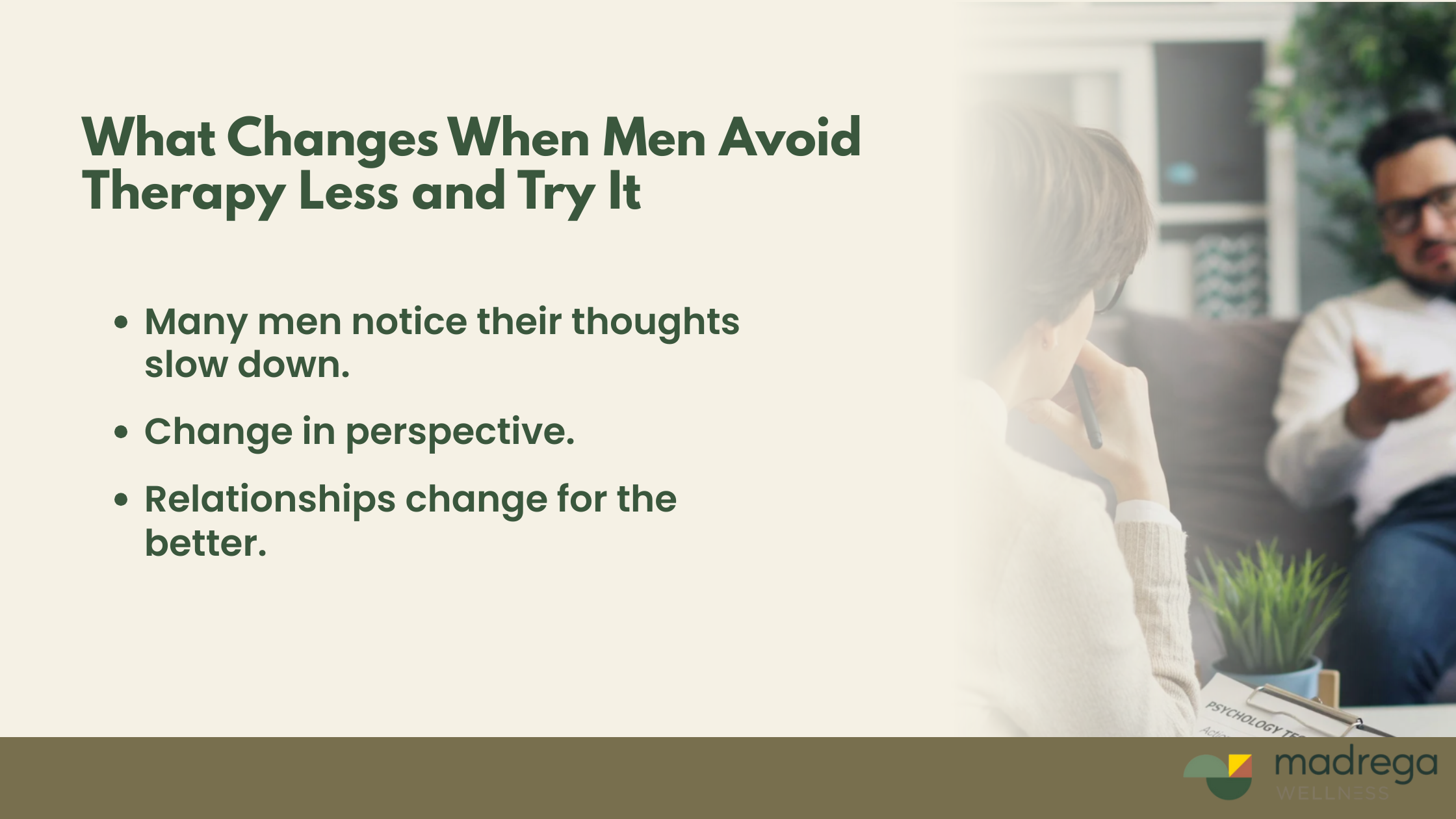
What Actually Changes When Men Avoid Therapy Less and Try It
When men avoid therapy less and try it, the first change isn’t dramatic; it’s relief. You stop carrying everything alone. Even naming what you’ve been holding can reduce the pressure you didn’t realize was constant.
Many men notice their thoughts slow down.
Situations that once triggered anger, shutdown, or overthinking feel more manageable. You don’t lose control, you gain clarity. Therapy helps you understand what’s driving your reactions instead of fighting them.
Another change is perspective.
Problems that felt overwhelming start to feel workable. You begin to separate who you are from what you’re dealing with. That separation restores confidence and emotional balance.
Relationships often shift, too.
When you feel more grounded, you listen better, communicate more clearly, and react less defensively. You don’t have to fix everything; you just show up more present. Read our article on What Healthy Communication for Men Really Looks Like.
Trying therapy doesn’t change who you are. It changes how much weight you carry. And for many men, that shift alone is enough to make life feel more livable again.

How Therapy Feels for Men Who Previously Avoided Therapy
For men who previously avoided therapy, the experience is often different than expected. It usually feels calmer and more practical than imagined. You’re not forced to talk before you’re ready, and you’re not judged for how you cope.
At first, therapy can feel unfamiliar. You may feel awkward, guarded, or unsure what to say. That’s normal. Many men notice relief simply from having a space where nothing needs to be fixed right away.
Over time, therapy feels grounding. You begin to understand your emotions instead of fighting them. Conversations feel structured and focused, not overwhelming. You leave sessions feeling clearer, not exposed.
Many men also notice a sense of control returning, not through suppression, but through awareness. You understand your reactions. You respond instead of reacting. That sense of steadiness builds confidence.
Therapy doesn’t turn you into someone else. It helps you feel more like yourself. Less tense, less burdened, and more capable of handling what life brings!
FAQ: Why Men Avoid Therapy
Q1. Why do men avoid therapy so often?
Men often avoid therapy because it feels emotionally risky, unfamiliar, and outside their comfort zone.
Q2. Is therapy actually helpful for men?
Yes. Many men find therapy helps them feel clearer, calmer, and more connected — often faster than expected.
Q3. What changes when men start therapy?
Men often experience relief, emotional clarity, improved communication, and reduced stress.
Q4. Does going to therapy mean something is wrong with you?
No. Therapy is a space for support and growth, not a sign of failure Written by the Madrega Wellness Team. A men’s therapy practice helping men move past emotional avoidance and build clarity, balance, and connection through compassionate, evidence-based care.