Why Men Experience Loss of Motivation Even When Life Is Stable

You can have a stable job, a steady routine, and a life that looks “fine” on the outside and still feel a quiet loss of motivation underneath it all. Many men describe it as going through the motions, waking up tired without knowing why, or feeling unmotivated for no clear reason. When life is stable, but you feel stuck, it’s rarely laziness; it’s often emotional burnout, disconnection, or something deeper asking for attention.
Why Do Men Experience Loss of Motivation When Nothing Seems Wrong?
This is one of the most confusing experiences for many men. On paper, nothing is falling apart. Work is steady. Bills are paid. Relationships might even be stable. And yet, something feels off.
Stability reduces chaos, but it doesn’t automatically create meaning. Many men spend years building structure and security, only to realize that “safe” doesn’t always feel fulfilling. When your energy drops despite everything looking fine, it’s often not about circumstances. It’s about engagement.
Loss of motivation can grow from emotional disconnection. You’ve been responsible for so long that you stopped asking what actually energizes you. Goals become habits. Habits become routines. And routines can slowly turn into autopilot.
There’s also the identity question that rarely gets asked: Who am I outside of achievement? When life becomes about maintaining stability instead of exploring purpose, something inside can go quiet.
Research shows that feeling stuck often isn’t about laziness; it’s about a mismatch between your current life structure and your internal state. When your outer world stays stable, but your inner world feels unexamined, motivation naturally declines.
Nothing has to be “wrong” for something to feel missing.
Is Loss of Motivation in Men a Sign of Burnout or Depression?
Sometimes it is. Sometimes it isn’t. That’s what makes it complicated.
Burnout in men often doesn’t look dramatic. It can show up as irritability, withdrawal, restlessness, or a strange mix of exhaustion and boredom. You might feel tired but unable to relax. Tasks that once felt manageable now feel heavier than they should.
Chronic stress drains mental energy over time. When your nervous system stays activated for too long, motivation fades naturally. It’s not about willpower, it’s about depletion. Many men describe this as feeling flat or detached rather than openly distressed.
Depression in men can look similar. It’s not always visible sadness. More often, it appears as low drive, constant fatigue, procrastination, or emotional numbness. You may still function at work or at home, but internally you feel disconnected from excitement or meaning.
If you’ve noticed ongoing low energy, irritability, or loss of interest, it’s worth paying attention. Burnout and depression can overlap in subtle ways, especially when stress goes unaddressed over time.
Not every dip in motivation means you’re depressed. But when the feeling lingers for months, or begins affecting relationships and self-perception, it’s a sign your system may need support, not more pressure.
Are You Feeling Unmotivated but can’t find a Reason?
This is where many men get frustrated with themselves. You look at your life and think, There’s no obvious problem. So why do I feel unmotivated?
Sometimes the answer isn’t dramatic. It’s a gradual emotional buildup.
When stress, disappointment, or pressure go unprocessed for years, your system adapts. You become efficient at pushing through. But over time, that same habit can dull excitement and curiosity. What feels like “no clear reason” is often accumulated strain that never had space to move.
Emotional numbness in men can also play a role here. When you suppress frustration, sadness, or even anger long enough, motivation fades with it. You don’t only mute difficult emotions, you mute drive and desire too.
There’s also identity fatigue. You may have followed the path that made sense. You built stability. You did what was expected. But if you never paused to ask what actually energizes you, motivation slowly declines. You’re not failing, you’re misaligned.
Sometimes men describe this as feeling stuck in life without being able to explain why. It’s not laziness. It’s often a signal that something internal needs attention, not more productivity.
How Does Emotional Numbness in Men Affect Drive and Ambition?
I’ve worked with men who say, “I’m not sad. I just don’t feel much.”
One client described it like this: “It’s like someone turned the volume down on everything. I’m functioning. I’m just not excited.”
Emotional numbness in men doesn’t always look dramatic. It often looks like competence without engagement. You show up. You complete tasks. You handle responsibilities. But internally, there’s no spark.
Ambition relies on emotional energy. You don’t chase goals purely with logic; you chase them with desire, curiosity, and meaning. When emotions are muted, the drive weakens too.
For many men, numbness develops slowly. Maybe you pushed through stress for years. Maybe you ignored disappointment. Maybe you trained yourself not to dwell on frustration. That survival skill worked. But over time, it also flattened joy.
Another man once told me, “I don’t know what I want anymore. Everything feels like maintenance.” That’s a common sign. Life becomes about sustaining what exists instead of creating something new.
Here’s what’s important: numbness is often protective. When the nervous system has been under long-term strain, it reduces emotional intensity to conserve energy. But in doing so, it reduces motivation as well.
That can look like:
Reintroducing small experiences that once brought interest
Reducing constant stimulation (screens, scrolling, noise)
Creating space to identify suppressed frustration or grief
Learning to notice emotional shifts in the body again
Our article on meditation for men explores simple ways to reconnect with internal awareness without turning it into something abstract or spiritual. Often, motivation begins returning when emotional awareness returns.

Can Work Stress in Men Quietly Lead to Lack of Motivation?
Many men tie their identity to their ability to perform, provide, or stay dependable. When work becomes the primary measure of worth, pressure slowly builds. You push through deadlines. You carry responsibility. You solve problems without pausing. And eventually, your energy begins to thin out.
Loss of motivation in men is often less about laziness and more about chronic output without recovery.
I’ve worked with men who say things like, “I’m not burned out. I’m just tired.” But when we look closer, they haven’t felt mentally clear in years. Their days are structured around responsibility, not renewal.
Work stress contributes to loss of motivation in three common ways:
Constant pressure reduces dopamine sensitivity.
When your brain stays in stress mode, reward systems dull. Achievements feel less satisfying.
Responsibility crowds out curiosity.
When your energy goes toward maintaining stability, there’s little left for growth or creativity.
Self-worth becomes performance-based.
If your value depends on productivity, rest begins to feel unsafe.
We explore this more deeply in our article on how work stress in men shapes identity. Many men don’t realize how deeply their motivation is tied to unspoken expectations about success. Work itself isn’t the problem. Chronic, unexamined pressure is.
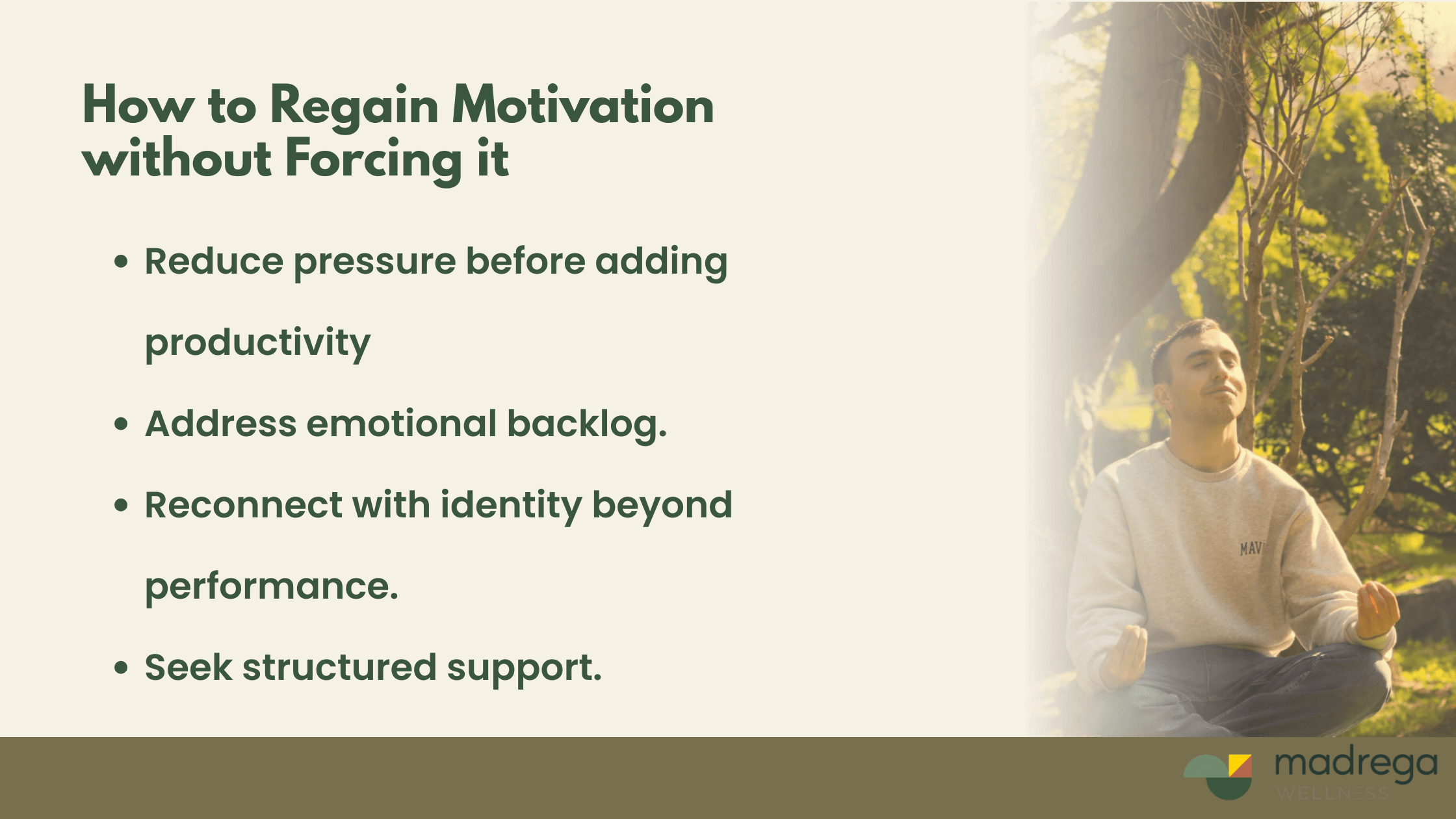
How Can You Regain Motivation Without Forcing Yourself?
The instinct when motivation drops is to push harder. Most men double down. They add structure, increase discipline, or criticize themselves into action.
That rarely works long-term.
Motivation isn’t restored through pressure. It returns when your system feels safe, clear, and engaged again.
Here are practical ways to begin without forcing it:
Reduce pressure before adding productivity.
If your baseline is stress, adding more goals won’t fix it. Look first at what can be simplified, delegated, or paused.
Shift from outcome-focused thinking to process-focused action.
Instead of asking, “What should I achieve?” ask, “What feels slightly interesting today?” Small curiosity often reignites a drive more effectively than big ambition.
Address emotional backlog.
Unprocessed frustration, disappointment, or fatigue quietly drains energy. Sometimes motivation returns after you acknowledge what you’ve been carrying.
Reconnect with identity beyond performance.
Who are you outside of achievement? Outside of being reliable? This question often feels uncomfortable, but it’s essential.
Seek structured support.
When loss of motivation lingers, therapy provides clarity without judgment. It helps you distinguish between burnout, emotional numbness, depression, and simple misalignment. You don’t have to figure it out alone. If you’re ready to talk, you can reach out here.
Regaining motivation isn’t about becoming someone new. It’s about restoring access to parts of yourself that have been muted by pressure and responsibility.
If life looks stable but feels flat, that’s not failure. It’s information.
And information can lead to change.
FAQ: Loss of Motivation in Men
Q1. Is it normal for men to experience loss of motivation even when life is stable?
Yes. Stability does not automatically create meaning. Many men experience a loss of motivation when emotional needs, identity questions, or chronic stress go unaddressed.
Q2. How do I know if my loss of motivation is depression?
If low energy, numbness, irritability, or disinterest last for weeks or months, especially alongside sleep changes or withdrawal, it may be depression. A professional evaluation can help clarify.
Q3. Can burnout cause loss of motivation in men?
Yes. Chronic stress and ongoing responsibility can drain emotional and mental energy. When recovery never happens, motivation naturally declines.
Q4. Why do I feel unmotivated for no clear reason?
Often, there is a reason, it just isn’t obvious. Emotional suppression, identity fatigue, or long-term pressure can quietly reduce drive over time.
Q5. Does therapy help with loss of motivation in men?
Therapy helps identify whether motivation loss is linked to burnout, depression, emotional numbness, or misalignment. Once the root is clear, change becomes practical instead of forced.